She had been getting filler in her nasolabial folds twice a year for three years, and each time the result was a little less satisfying than the last. The folds softened briefly, but her face was starting to look heavier overall, fuller in a way she could not quite name, and the folds always came back. When she finally consulted a surgeon in Seoul about why filler kept failing her, he explained something no one had told her. Her folds were not deepening because she was losing volume in the fold itself. They were deepening because her cheeks were sagging, and pumping filler into a fold caused by sagging was adding weight to a face that needed lifting, not filling. The consultation at Link Plastic Surgery often starts by figuring out why a fold formed before deciding how to treat it.
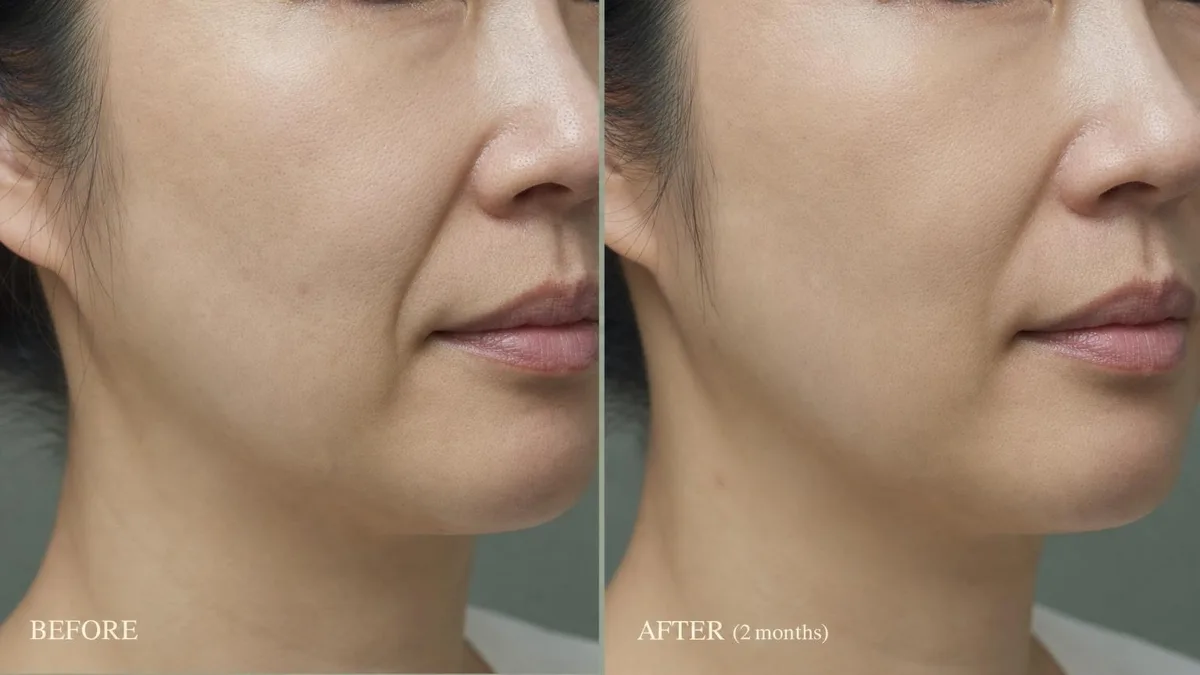
Nasolabial folds, the lines running from the nose to the corners of the mouth, are one of the most common aging concerns foreign patients bring to Korean clinics, and filler is the default answer almost everywhere. But filler is only one of three genuinely different ways to address a fold, and it is frequently the wrong one. Understanding why a fold forms determines which of the three tools actually fixes it, and choosing wrong is how people end up with a heavier, overfilled face instead of a softer one.
Three Ways to Soften a Fold
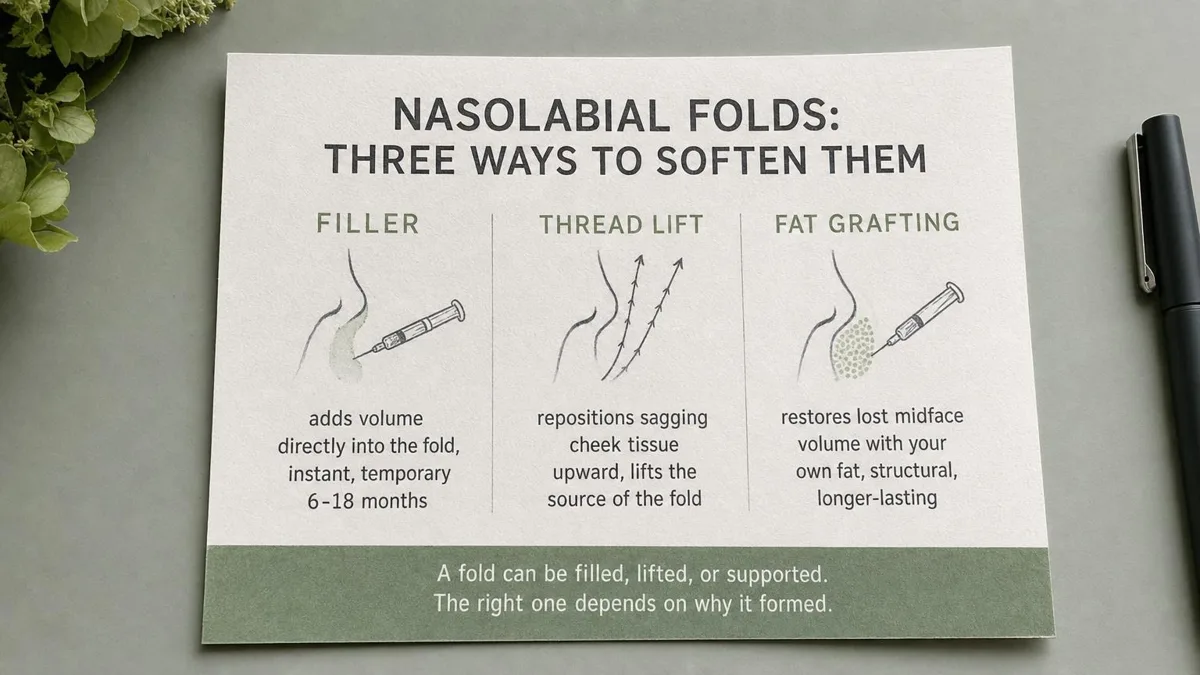
There are three distinct approaches to nasolabial folds, and they are not interchangeable because they do fundamentally different things to the face.
Filler adds volume directly into or beside the fold, pushing it out so it sits less deep. It is instant and the most common approach, but it is temporary, lasting somewhere between six and eighteen months, and it does nothing about the underlying cause if that cause is sagging. Thread lifting takes a different approach entirely: instead of filling the fold, it repositions the sagging cheek tissue upward, lifting the source of the fold rather than masking it. Fat grafting is the third route, restoring lost midface volume using your own fat, which is structural and longer-lasting than filler. The detailed surgical context of these is covered in our guides to the Korean flower lift thread procedure and Korean facial fat grafting. The key idea is that a fold can be filled, lifted, or structurally supported, and which one is right depends on why it formed.
Why Nasolabial Folds Form
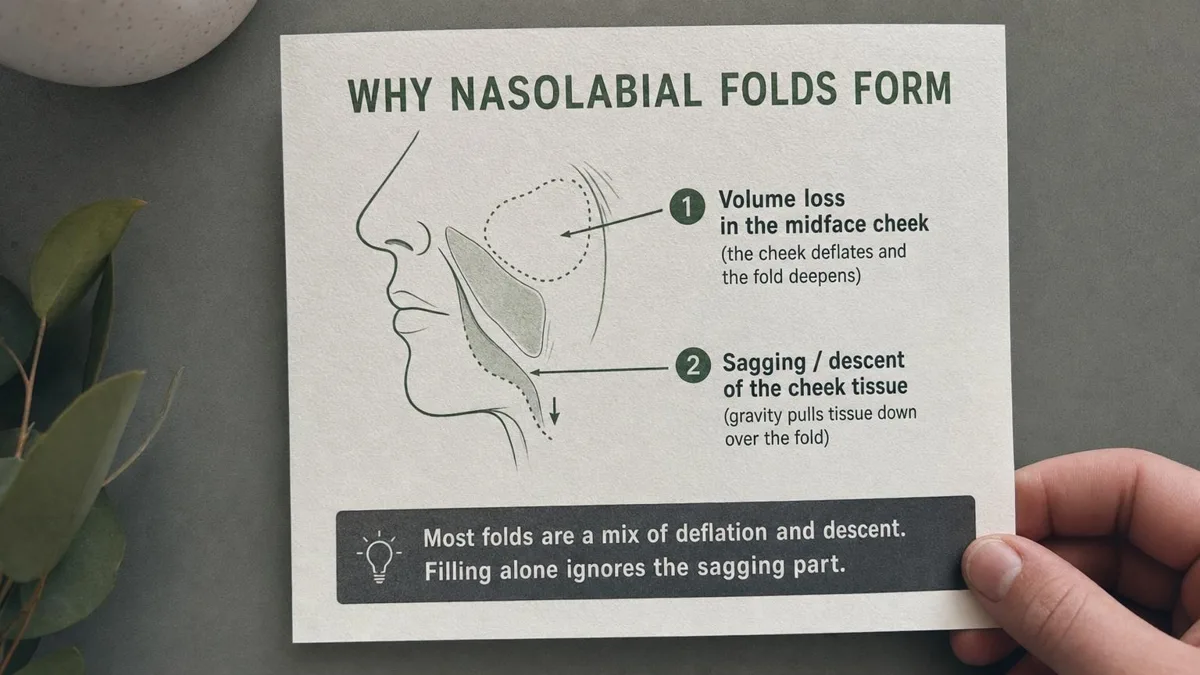
Understanding the cause is the whole point, because the two main causes call for opposite solutions. Folds deepen for two reasons that usually coexist.
The first is volume loss. The midface cheek deflates with age, and as it loses its fullness the fold beneath it deepens, much like a cushion losing its stuffing. The second is sagging, or descent. The cheek tissue itself drifts downward under gravity over the years, piling up above the fold and pressing it deeper. Most nasolabial folds are a combination of both deflation and descent, and the proportion between them is what dictates treatment. A fold that is mostly deflation responds well to adding volume back. A fold that is mostly descent needs the tissue lifted, and filling it only adds more weight to tissue that is already sagging, which is exactly the trap the patient at the start fell into. This is why a careful look at the cause comes before the choice of tool, the same principle that guides the broader range of Korean non-surgical petit treatments.
Which Option Fits Which Fold
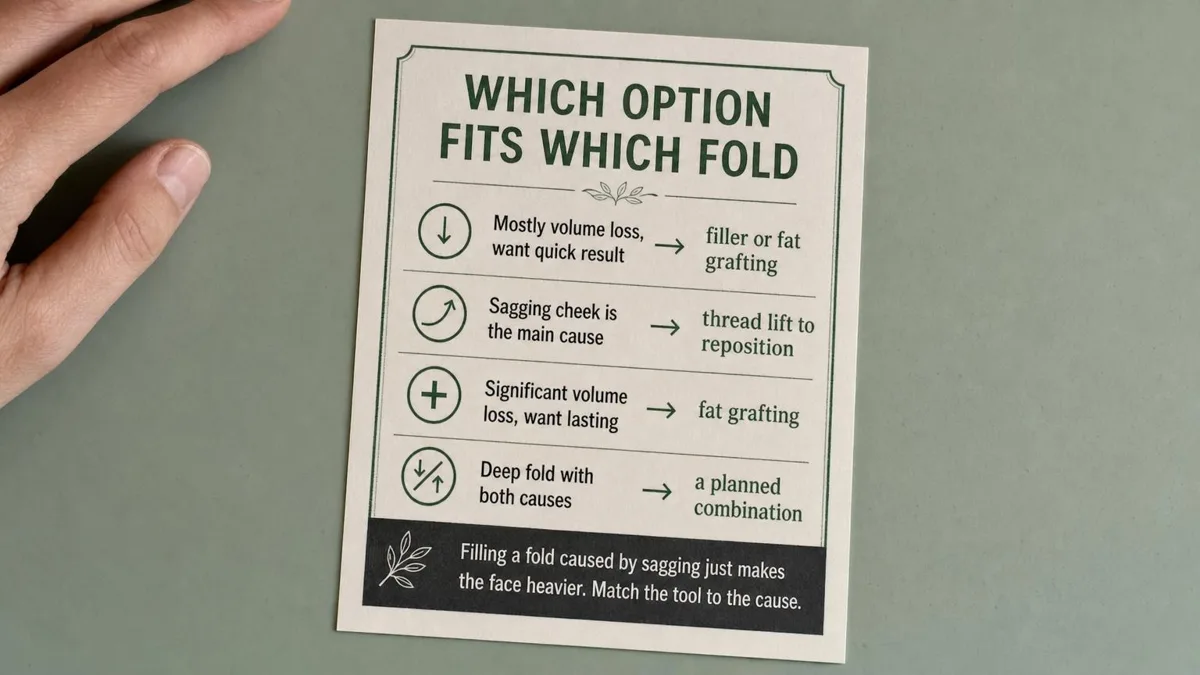
Once the cause is clear, the right option follows. The decision turns on what is driving the fold and how lasting a result you want.
If the fold is mostly volume loss and you want a quick result, filler or fat grafting fit, with filler being faster and temporary and fat grafting being a procedure but longer-lasting. If sagging cheek tissue is the main cause, a thread lift to reposition that tissue is the logical answer, because adding volume would only make it heavier. If there is significant volume loss and you want a durable result rather than repeated top-ups, fat grafting is the structural choice. And for a deep fold driven by both deflation and descent, which is very common past the late thirties, a planned combination of lifting and volume restoration gives the most natural result. The mistake to avoid is defaulting to filler for every fold regardless of cause. Filling a fold that is caused by sagging does not fix it; it just makes the face heavier, which is the single most common way nasolabial treatment goes wrong.
Keeping It Natural
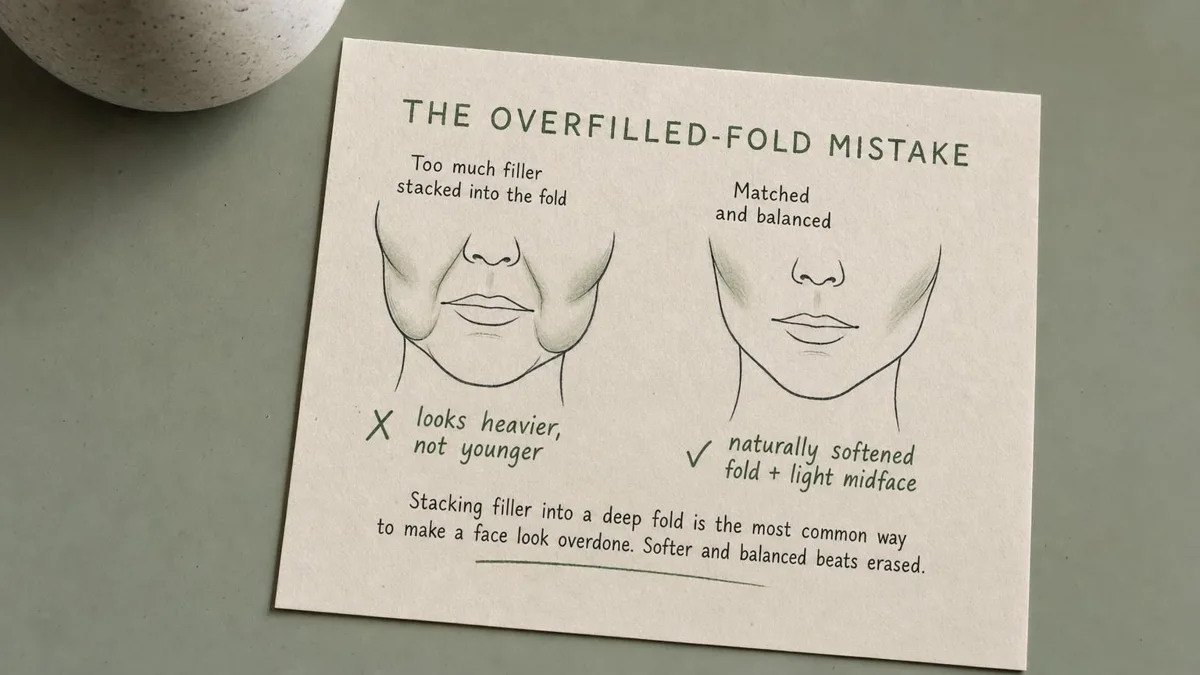
The nasolabial area is one of the easiest places to overdo, and the overfilled fold is an instantly recognizable look: a heavy, pillowed midface that reads as work done rather than as a younger face. It happens because each visit adds a little more filler to a fold that keeps coming back, and the volume accumulates without ever addressing why the fold is there. The Korean aesthetic standard treats this area conservatively, aiming to soften the fold and support the midface in balance rather than erase the line completely.
A fold that is softened and balanced looks younger; a fold that is flattened with stacked filler looks heavier. This is why matching the tool to the cause matters not just for effectiveness but for naturalness. A thread lift on a sagging fold, or fat grafting to genuinely restore lost volume, addresses the cause and keeps the face light, whereas repeated filler on the wrong fold builds the very heaviness patients are trying to avoid. The same restraint applies across the face, including in related work covered in our Korean facial procedure guides.

Cost and How to Verify the Plan
Pricing varies by approach. Filler is the lowest upfront but recurs every six to eighteen months, so the cost compounds over the years. Thread lifting and fat grafting cost more upfront but last longer, which often makes them more economical over time for someone treating a persistent fold. These costs are generally below the equivalent abroad, part of why facial work anchors so many Seoul trips. The right comparison is not the single-session price but the cost over several years given how each option lasts.
Before committing, five questions tell you whether a surgeon is assessing the cause or defaulting to filler. Did the surgeon explain why your fold formed, deflation, descent, or both? If filler is proposed, why is it right for your cause rather than a thread lift or fat? If your cheek is sagging, why would filling rather than lifting help? What is the realistic longevity of the recommended option, and the cost over a few years? And how is the result kept natural rather than heavy? A surgeon who answers these, and who is willing to say filler is the wrong tool for your fold, is the one to trust. For trip-planning details, visit Link Plastic Surgery’s official website.
Q. Why does my nasolabial filler keep failing?
Most often because your fold is driven by sagging rather than volume loss, and filler does not address sagging. Filling a fold caused by descending cheek tissue adds weight without lifting the cause, so the fold returns and the face looks heavier. The fix is to identify the cause first, which may point to a thread lift instead.
Q. Is filler or fat grafting better for nasolabial folds?
It depends on what you want. Filler is instant and temporary, lasting six to eighteen months. Fat grafting is a procedure but uses your own tissue and lasts longer. For a fold that is mostly volume loss, both work; fat grafting suits those who want a durable result rather than repeated filler over the years.
Q. What is a thread lift and when is it the right choice?
A thread lift uses sutures to reposition sagging cheek tissue upward, lifting the source of the fold rather than filling it. It is the right choice when the main cause of the fold is descent, sagging cheek tissue, rather than volume loss, because lifting addresses what filling cannot.
Q. Can filler make my face look worse?
Yes, if used on the wrong type of fold or overfilled. Stacking filler into a fold caused by sagging adds weight and can create a heavy, pillowed midface that looks overdone rather than younger. This overfilled look is the most common way nasolabial treatment goes wrong.
Q. Can these be combined?
Yes, and for deep folds driven by both volume loss and sagging, a combination is often the most natural answer. Typically a lift addresses the descent and volume restoration addresses the deflation, planned together rather than relying on one tool to do everything.
Q. How long do the results last?
Filler lasts roughly six to eighteen months. Thread lift results generally hold one to two years while also stimulating some collagen. Fat grafting is the longest-lasting because the surviving fat is structural, though only a portion of grafted fat takes. The trade is upfront cost and recovery against how long the result holds.
Q. Are nasolabial folds just about age?
Largely, but not entirely. Facial structure, volume distribution, and how the skin and cheek tissue age all play a role, which is why some people develop folds earlier than others. The treatment principle is the same regardless: match the tool to whether the cause is deflation, descent, or both.
Q. Does the approach differ for Asian and Western faces?
The three tools and the cause-based logic are the same. Differences in midface structure and fat distribution can change how a fold presents and how much volume or lift is needed, so the surgeon adjusts the specifics. The principle of treating the cause rather than just the line is universal.
Q. Will treating the fold change the rest of my face?
It can, which is why it should be planned in the context of the whole midface. Restoring cheek volume or lifting sagging tissue affects the surrounding area, ideally for the better, but overfilling just the fold in isolation is what creates an unbalanced, heavy look. Good planning considers the midface as a whole.
Q. How do I plan nasolabial treatment as an international patient?
Have a consultation that identifies the cause of your fold and chooses a tool to match, and weigh longevity since filler needs regular top-ups that are hard to maintain from abroad. For scheduling and trip-planning details, visit Link Plastic Surgery’s official website.